
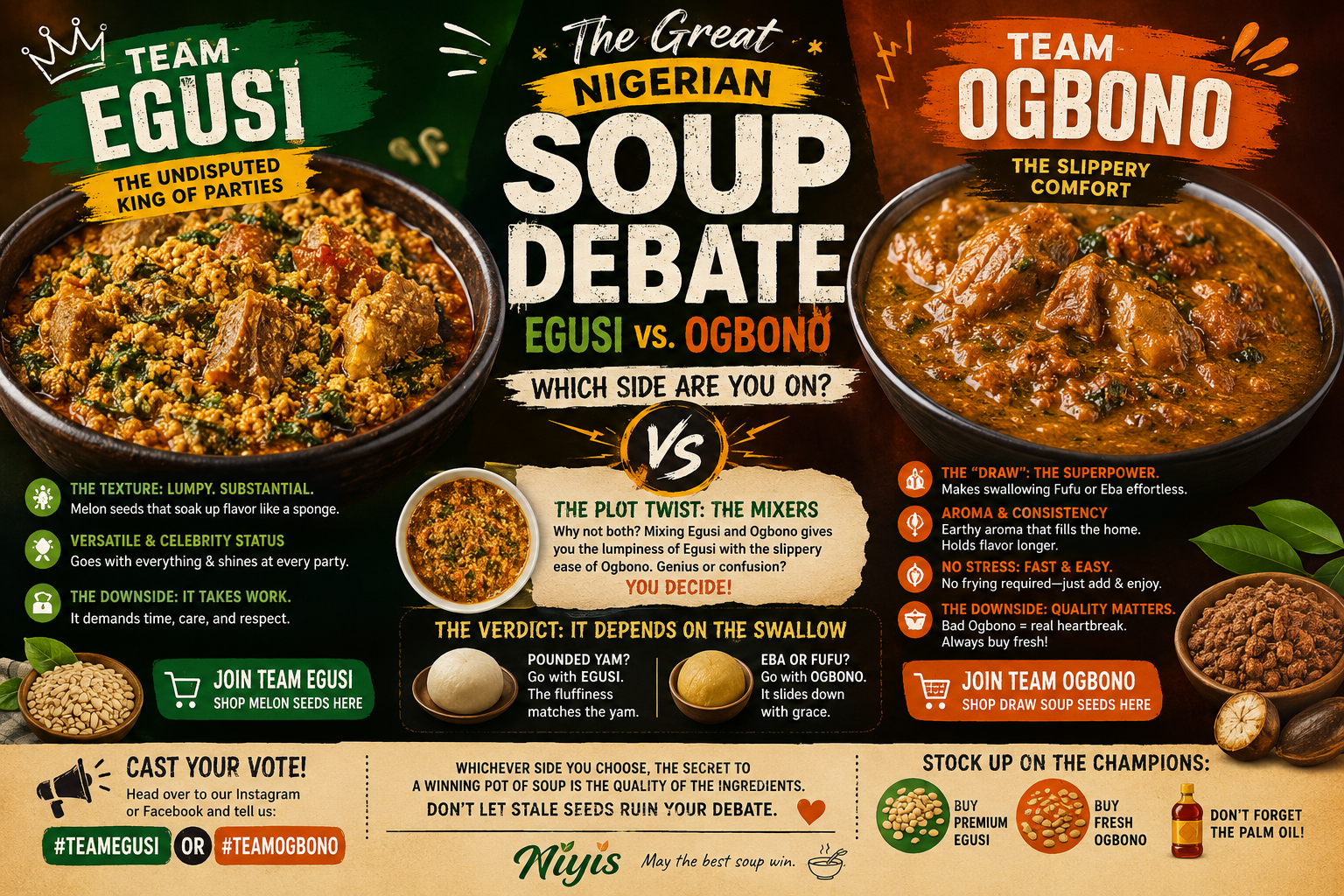
There are certain questions that can divide a Nigerian household instantly. "Jollof Rice: Ghana or Nigeria?" (We all know the answer to that one). "Chicken: Soft or Hard?" But the biggest, most emotional debate of all happens over the soup pot.
Egusi or Ogbono?

These two soups are the titans of Nigerian cuisine. They are the comfort food we crave after a long day, the centerpiece of every wedding, and the reason we lick our fingers.
But if you had to choose only one to eat for the rest of your life, which would it be?
At Niyis, we sell thousands of packs of both Egusi and Ogbono every month. To settle the score once and for all, we are breaking down the strengths of each contender.
Team Egusi: The Undisputed King of Parties

The Profile: Made from ground melon seeds, spinach (or bitter leaf), palm oil, and stockfish.
Why We Love It:
-
The Texture: There is nothing like the mouthfeel of "lumpy" Egusi. It has substance. It feels like a full meal. When fried properly, the melon seeds form curds that soak up the flavor of the meat and crayfish like a sponge.
-
Versatility: You can cook it "frying method" or "boiling method." You can add vegetables or leave it plain. It goes with everything—Pounded Yam, Eba, Fufu, even Rice (if you are adventurous).
-
The "Party" Factor: You rarely see Ogbono served at a high-class wedding. Egusi is the celebrity soup. It dresses up well.
The Downside: It takes work. Peeling the melon, grinding it, frying it perfectly so it doesn't burn... Egusi demands respect and time.
Join Team Egusi: Shop Melon Seeds Here
Team Ogbono: The Slippery Comfort

The Profile: Made from ground African mango seeds (Wild Mango). It is famous for its mucilaginous ("draw") texture.
Why We Love It:
-
The "Draw": This is the superpower. That slippery texture makes swallowing Fufu or Eba effortless. It coats the throat and provides a uniquely satisfying sensation that Egusi just can't match.
-
The Aroma: Good Ogbono has a distinct, earthy aroma that fills the whole house.
-
Consistency: Unlike Egusi which can go sour if not preserved well, Ogbono (when cooked right) tends to hold its flavor longer in the pot.
-
No Stress: It is generally faster to cook. No frying required—just dissolve the powder in hot palm oil and watch the magic happen.
The Downside: If you get "bad" Ogbono that has lost its elasticity, the heartbreak is real. (That is why you should only buy Fresh Ogbono from Niyis).
Join Team Ogbono: Shop Draw Soup Seeds Here
The Plot Twist: The Mixers
Then, there are the peacemakers. The people who say, "Why not both?"
Mixing Egusi and Ogbono in one pot is a controversial but delicious move. You get the lumpiness of the Egusi with the slippery ease of the Ogbono. Is it genius? Or is it confusion?
The Verdict: It Depends on the Swallow

Perhaps the winner depends on what you are holding in your hand.
-
If you have a wrap of soft, hot Pounded Yam, Egusi is usually the preferred partner. The fluffiness matches the yam.
-
If you have a dense ball of Yellow Garri (Eba) or Fufu, Ogbono helps it slide down with grace.
Cast Your Vote!
We want to hear from you. Head over to our Instagram or Facebook and tell us: #TeamEgusi or #TeamOgbono?
Whichever side you choose, the secret to a winning pot of soup is the quality of the ingredients. Don't let stale seeds ruin your debate.
Stock up on the champions:
May the best soup win.
Share:
How to Prepare Bitterleaf Soup (And Where to Buy Fresh Leaves in UK)
Healthy Nigerian Foods for Gym Diets: Build Muscle and Boost Performance in the UK (2026)